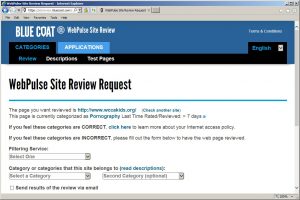
As a follow-up to our post about the number of sites miscategorized by SmartFilter, our tests with Blue Coat show that miscategorization is not a problem limited to a single product. We should be skeptical of any company’s claims that they are able to categorize much of the web accurately, or that their rate of “collateral damage” is very low.
The Citizen Lab at the Munk School of Global Affairs, University of Toronto is one of ten non-profits in the U.S. and abroad to receive the New Digital Age Grants, funded through a $1 million donation by Google executive chairman Eric Schmidt and his wife, Wendy.
On January 20, 2014 the Citizen Lab along with leading Canadian academics and civil liberties groups asked Canadian telecommunications companies to reveal the extent to which they disclose information to state authorities. This post summarizes and analyzes the responses from the companies, and argues that the companies have done little to ultimately clarify their disclosure policies. We conclude by indicating the subsequent steps in this research project.
Where do human rights and online rights meet? Is there a clash between online freedom and human rights? Is there room for self-regulation? These are some of the questions that a recently concluded online discussions report on Internet freedom in Africa explores.
Citizen Lab Post-doctoral Fellow Chris Parsons was interviewed by a number of media outlets with regard to surveillance and privacy.
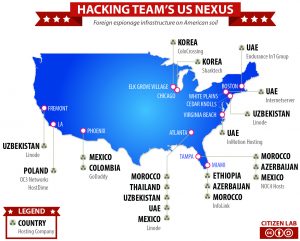
Our analysis traces Hacking Team’s Remote Control System’s (RCS) proxy chains, and finds that dedicated US-based servers are part of the RCS infrastructure implemented by the governments of Azerbaijan, Colombia, Ethiopia, Korea, Mexico, Morocco, Poland, Thailand, Uzbekistan, and the United Arab Emirates in their espionage and/or law enforcement operations.
This report outlines an extensive US nexus for a network of servers forming part of the collection infrastructure of Hacking Team’s Remote Control System. The network, which includes data centers across the US, is used to obscure government clients of Hacking Team. It is used by at least 10 countries ranging from Azerbaijan and Uzbekistan to Korea, Poland and Ethiopia. In addition we highlight an intriguing US-only Hacking Team circuit.
An article on commercial spyware in Voice of America cited Citizen Lab research into ‘lawful intercept’ spyware such as FinSpy.
Citizen Lab research into FinSpy, a suite of surveillance software marketed exclusively to governments by the Gamma Group of Companies, has helped in the recent lawsuit put forth by an American citizen living in Maryland.
Citizen Lab’s Bill Marczak helped Privacy International scan Ethiopian refugee Tadesse Biru Kersmo’s computer, and they found traces that showed FinSpy had been operating in June 2012 over two days while he was in the UK.