On June 28, join Citizen Lab director Ron Deibert, author of Chasing Shadows, for this book talk at the Toronto International Festival of Authors.

In the past decade, we have seen a significant shift in how governments talk about misinformation. Many countries now consider or intentionally frame misinformation as a matter of national security or public safety in order to justify the passage of new laws that impose penalties for the spread of information deemed false or other administrative […]
In May 2025, Keir Giles, a well-known expert on Russian military operations, was targeted with a highly sophisticated and personalized phishing attack. Using a method not previously observed by the Citizen Lab, the attacker posed as a U.S. State Department employee to convince Mr. Giles to create and send app-specific passwords for his email accounts, bypassing multi-factor authentication. Google spotted and blocked the attack, attributing it to a Russian state-backed operator.
Our preliminary analysis of Bill C-2 situates the legislation within the context of existing research by the Citizen Lab about two potential data-sharing treaties that are most relevant to the new proposed powers being introduced in Bill C-2: the Second Additional Protocol to the Budapest Convention (2AP) and the CLOUD Act. Both of which carry significant constitutional and human rights risks.

Irene Poetranto examines Indonesia’s use of domain name system (DNS) redirection as a method of internet censorship in a new essay published by the Carnegie Endowment for International Peace. In Techno-Legal Internet Controls in Indonesia and Their Impact on Free Expression Poetranto explains how DNS redirection, a new type of DNS tampering, was introduced in […]

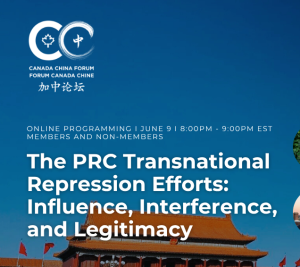
On June 9, join the Citizen Lab’s Emile Dirks to discuss China’s influence, interference, and repression in Canada.
On May 13, 2025, the Citizen Lab’s senior researcher John Scott-Railton testified before the European Union Parliament’s Committee on Civil Liberties, Justice and Home Affairs (‘LIBE committee’) to share findings from our recent report on the proliferation of Paragon spyware. “When we look at the pie chart of [spyware] targeting to see who was targeted […]

Join us on May 21 for a hybrid workshop that explores digital sovereignty, the methodologies for its study, and the global trend around sovereignty in the digital world. This workshop is co-organized by DIGISOV, CIS CNRS, and GEODE and will take place on May 21, 2025, from 9:30 to 17:00, in Paris 17th (CNRS Pouchet) […]

New paper co-authored by researchers at the Citizen Lab and Princeton University explores the network security of Android apps.
In his article for Foreign Affairs, Citizen Lab founder Ron Deibert discusses the lessons of SignalGate, highlighting that “much of the debate has downplayed an even larger problem: the very real possibility that a foreign government or other hostile power was snooping on the devices through which those communications were taking place.” Read the full […]