Research
When the general public becomes increasingly aware of online surveillance attempts, how do they respond? Jon Penney, research fellow at Citizen Lab, looks into how individuals navigate this digital landscape and who is most likely to alter their behaviour.

The international investigation into the 2014 Iguala Mass Disappearance was targeted with infection attempts using spyware developed by the NSO group.

This report reveals a campaign of reconnaissance, phishing, and malware operations that use content and domains made to mimic Chinese language news websites.

This report reveals a campaign of reconnaissance, phishing, and malware operations that use content and domains made to mimic Chinese language news websites.
NSO Group’s Pegasus spyware and exploit framework were used in infection attempts against Mexican senators and senior politicians in June and July 2016.
Uncovering an operation using NSO Group’s Pegasus spyware and Trident exploit framework to target Mexican journalists, lawyers, and even a minor child.

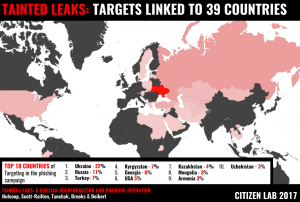
Documents stolen from a prominent journalist and critic of the Russian government were manipulated and then released as a “leak” to discredit domestic and foreign critics of the government. We call this technique “tainted leaks.”
Former Google Policy Fellow Adrian Fong has published a paper titled “The Role of App Intermediaries in Protecting Data Privacy,” based on research that he had conducted, in part, at the Citizen Lab in summer 2016. The paper was published in the International Journal of Law and Technology.

This report analyzes the information control practices related to a national crackdown on Chinese rights lawyers and activists on two leading Chinese social media networks. We document the Search filtering on Weibo, China’s Twitter-like service, as well as keyword and image censorship on WeChat, the most popular chat app in China.
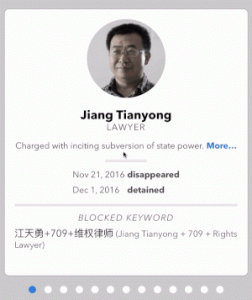
This report analyzes the information control practices related to a national crackdown on Chinese rights lawyers and activists on two leading Chinese social media networks. We document the Search filtering on Weibo, China’s Twitter-like service, as well as keyword and image censorship on WeChat, the most popular chat app in China.