Report
This report describes an elaborate phishing campaign using two-factor authentication against targets in Iran’s diaspora, and at least one Western activist.

This article, written by Postdoctoral Fellow Christopher Parsons and CIPPIC Staff lawyer Tamir Israel, analyzes how successive federal governments of Canada have actively sought to weaken the communications encryption available to Canadians. The article covers regulations imposed on mobile telecommunications providers, state authorities’ abilities to compel decryption keys from telecommunications providers writ large, and Canada’s signals intelligence agency’s deliberate propagation of flawed encryption protocols.

In this paper presented at USENIX FOCI 2015 we use reverse engineering to provide a view into how keyword censorship operates on four popular social video platforms in China: YY, 9158, Sina Show, and GuaGua. We also find keyword surveillance capabilities on YY. Our findings show inconsistencies in the implementation of censorship and the keyword lists used to trigger censorship events between the platforms we analyzed. We reveal a range of targeted content including criticism of the government and collective action. These results provide evidence that there is no monolithic set of rules that govern how information controls are implemented in China.

This research note outlines what we know about the use of Hacking Team’s Remote Control System (RCS) by South Korea’s National Intelligence Service (NIS). The note synthesizes information found in publicly leaked materials, as well as our own research.

This report is an analysis of the types of content removed by WeChat on its public accounts (also known as “official accounts”) blogging platform.

This post analyzes targeted malware attacks against groups in the Tibetan diaspora and Hong Kong that leverage the CVE-2014-4114 vulnerability

The report, authored by Postdoctoral Fellow Christopher Parsons, examines how contemporary telecommunications surveillance is governed in Canada. He concludes that serious failures in transparency and accountability indicate that corporations are failing to manage Canadians’ personal information responsibly and that government irresponsibility surrounding accountability strains its credibility and aggravates citizens’ cynicism about the political process.

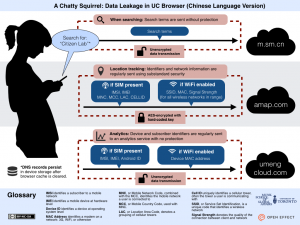
UC Browser is the most popular mobile web browser in China and India, boasting over 500 million users. This report provides a detailed analysis of how UC Browser manages and transmits user data, particularly private data, during its operation. Our research was prompted by revelations in a document leaked by Edward Snowden on which the Canadian Broadcasting Corporation (CBC) was preparing a story.
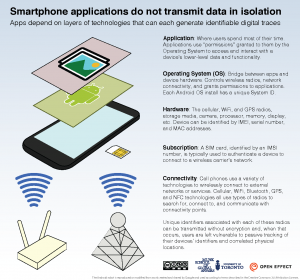
This document describes key identifiers used by mobile devices, highlights some identifiers that are accessible, and often collected, by various parties and the risks associated with the widespread transmission and use of these identifiers.
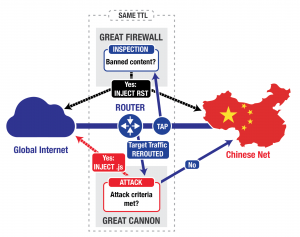
This post describes our analysis of China’s “Great Cannon,” our term for an attack tool that we identify as separate from, but co-located with, the Great Firewall of China. The first known usage of the Great Cannon is in the recent large-scale novel DDoS attack on both GitHub and servers used by GreatFire.org.