Report
In this work, we study how Tencent implements image filtering on WeChat. We found that Tencent implements realtime, automatic censorship of chat images on WeChat based on what text is in an image and based on an image’s visual similarity to those on a blacklist. Tencent facilitates this realtime filtering by maintaining a hash index of MD5 hashes of sensitive image files.

This report provides an in-depth legal and policy analysis of technology-facilitated intimate partner surveillance (IPS) under Canadian law. Stalkerware apps are designed to facilitate remote surveillance of an individual’s mobile device use with the surveillance often being covert or advertised as such. Despite increasing recognition of the prevalence of technology-enabled intimate partner abuse and harassment, the legality of the creation, sale, and use of consumer-level spyware apps has not yet been closely considered by Canadian courts, legislators, or regulators.

This report was collaboratively written by researchers from computer science, political science, criminology, law, and journalism studies. As befits their expertise, the report is divided into several parts, with each focusing on specific aspects of the consumer spyware ecosystem, which includes: technical elements associated stalkerware applications, stalkerware companies’ marketing activities and public policies, and these companies’ compliance with Canadian federal commercial privacy legislation.

In the days leading up to the 30th anniversary of June 4 1989, YY, a popular live streaming platform in mainland China, updated its keyword blacklists with content focused on Democracy Movement related memorials and activism in Hong Kong.

In the days leading up to the 30th anniversary of June 4 1989, YY, a popular live streaming platform in mainland China, updated its keyword blacklists with content focused on Democracy Movement related memorials and activism in Hong Kong.
In the days leading up to the 30th anniversary of June 4 1989, YY, a popular live streaming platform in mainland China, updated its keyword blacklists with content focused on Democracy Movement related memorials and activism in Hong Kong.
Endless Mayfly is an Iran-aligned network of inauthentic websites and online personas used to spread false and divisive information primarily targeting Saudi Arabia, the United States, and Israel. Using this network as an illustration, this report highlights the challenges of investigating and addressing disinformation from research and policy perspectives.

This research brief details how Griselda Triana, journalist and the wife of slain journalist Javier Valdez Cárdenas, was targeted with NSO Group’s Pegasus spyware in the days after his killing.

This report details how colleagues of a slain Mexican journalist investigating cartels were targeted with NSO Group’s Pegasus spyware in the days after his killing.

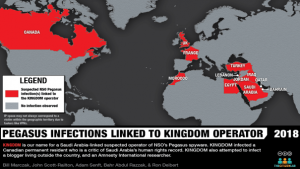
In this report, we describe how Canadian permanent resident and Saudi dissident Omar Abdulaziz was targeted with a fake package delivery notification. We assess with high confidence that Abdulaziz’s phone was infected with NSO’s Pegasus spyware. We attribute this infection to a Pegasus operator linked to Saudi Arabia.