Publications
At least five civil society victims of QuaDream’s spyware and exploits were identified in North America, Central Asia, Southeast Asia, Europe, and the Middle East. Victims include journalists, political opposition figures, and an NGO worker. We identify traces of a suspected iOS 14 zero-click exploit used to deploy QuaDream’s spyware.

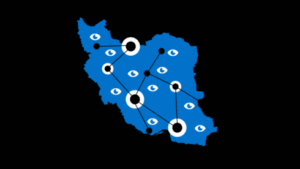
A confidential source sent the online news organization, The Intercept, a series of internal documents and communications providing details on what appear to be plans to develop and launch an Iranian mobile network, including subscriber management operations and services, and integration with a legal intercept solution. Some of this communication included representatives of the Communications Regulatory Authority of Iran (CRA). In October 2022, The Intercept shared this material with Citizen Lab researchers for analysis. The following report provides a summary of our analysis of this material and discusses its wider implications.
In this report, we describe how activists and dissidents living in Canada are impacted by digital transnational repression. We conclude that digital transnational repression has a serious impact on these communities, including their ability to undertake transnational advocacy work related to human rights. Yet, there is little support for victims who experience such targeting and policy efforts by the Canadian government to date have been insufficient.

Our forensic analysis confirms that phones belonging to three individuals in Bahrain were hacked in 2021 with NSO Group’s Pegasus spyware.

The Citizen Lab and Access Now have confirmed 35 cases of journalists and members of civil society whose phones were successfully infected with NSO’s Pegasus spyware between July 2020 and November 2021. We shared a sample of forensic data with Amnesty International’s Security Lab which independently confirms the findings.