Publications
This report provides a detailed, mixed methods analysis of Information controls related to the Yemen armed conflict, with research commencing at the end of 2014 and continuing through October 20, 2015. The research confirms that Internet filtering products sold by the Canadian company Netsweeper have been installed on and are presently in operation in the state-owned and operated ISP YemenNet, the most utilized ISP in the country.

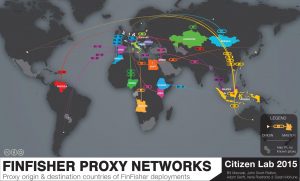
This post describes the results of Internet scanning we conducted to identify the users of FinFisher, a sophisticated and user-friendly spyware suite sold exclusively to governments.
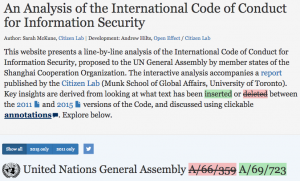
As the United Nations General Assembly begins its milestone 70th session, international digital security is high on the agenda. One starting point for discussion is likely to be the International Code of Conduct for Information Security (the “Code”). This analysis explores how the Code has developed over time, impetus behind the changes made, and the potential impact of the Code on international human rights law and its application. It is accompanied by an interactive comparison of the 2015 and 2011 versions of the Code.
This report describes the results of two independent security audits of Smart Sheriff, one by researchers who collaborated at the 2015 Citizen Lab Summer Institute (held at the Munk School of Global Affairs, University of Toronto), and the other by the auditing firm Cure53. The combined audits identified twenty-six security vulnerabilities in recent versions of Smart Sheriff (versions 1.7.5 and under). These vulnerabilities could be leveraged by a malicious actor to take control of nearly all Smart Sheriff accounts and disrupt service operations.

This research note outlines what we know about the use of Hacking Team’s Remote Control System (RCS) by South Korea’s National Intelligence Service (NIS). The note synthesizes information found in publicly leaked materials, as well as our own research.
