Publications
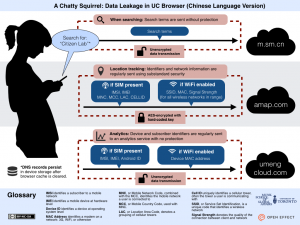
UC Browser is the most popular mobile web browser in China and India, boasting over 500 million users. This report provides a detailed analysis of how UC Browser manages and transmits user data, particularly private data, during its operation. Our research was prompted by revelations in a document leaked by Edward Snowden on which the Canadian Broadcasting Corporation (CBC) was preparing a story.
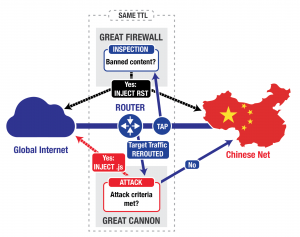
This post describes our analysis of China’s “Great Cannon,” our term for an attack tool that we identify as separate from, but co-located with, the Great Firewall of China. The first known usage of the Great Cannon is in the recent large-scale novel DDoS attack on both GitHub and servers used by GreatFire.org.
Senior Legal Advisor Sarah McKune has contributed a chapter to a new book from Oxford University Press, China and Cybersecurity: Espionage, Strategy and Politics in the Digital Domain (eds. Jon R. Lindsay, Tai Ming Cheung, Derek S. Reveron). Her chapter is entitled “’Foreign Hostile Forces’: The Human Rights Dimension of China’s Cyber Campaigns.”
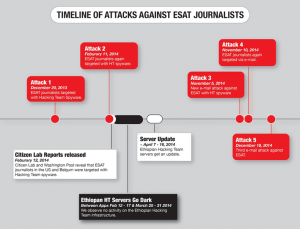
The research findings documented in this report suggest that Hacking Team may have continued to provide updated versions of its spyware to the same attacker who have targeted ESAT journalists based in the United States in 2014, despite reports of use of the spyware against journalists.
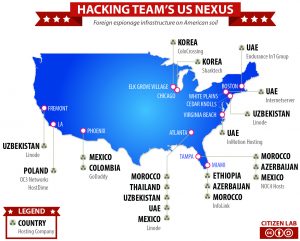
This report outlines an extensive US nexus for a network of servers forming part of the collection infrastructure of Hacking Team’s Remote Control System. The network, which includes data centers across the US, is used to obscure government clients of Hacking Team. It is used by at least 10 countries ranging from Azerbaijan and Uzbekistan to Korea, Poland and Ethiopia. In addition we highlight an intriguing US-only Hacking Team circuit.