Publications
This post is an update to our report on regionally-based keyword censorship in the popular chat application LINE. It covers responses from LINE Corporation to questions around censorship functionality in the application and recent changes to how keyword censorship and traffic encryption operate in the latest versions of LINE.

This post is an introduction to Asia Chats, a research project analyzing information controls and privacy in mobile messaging applications used in Asia. The project will produce a series of reports that will begin with a focus on WeChat, LINE, and KakaoTalk. Reports will include analysis based on our technical investigation of censorship or surveillance functionality, assessment of privacy issues surrounding these applications’ use and storage of user data, and comparison of the terms of service and privacy policies of the applications.
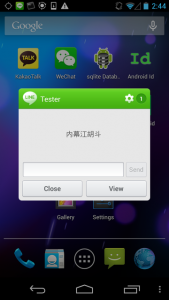
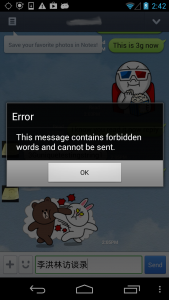
This report by Seth Hardy (Senior Security Analyst, Citizen Lab) describes the technical details of client-side censorship functionality in the LINE messenger client for Android, and a method for disabling it.
This post is the first in a series of research reports analyzing information controls and privacy in mobile messaging applications used in Asia. An introduction to the project can be found here
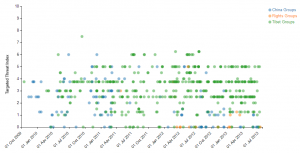
The Targeted Threat Index is a metric for assigning an overall threat ranking score to email messages that deliver malware to a victim’s computer. The TTI metric was first introduced at SecTor 2013 as part of the talk “RATastrophe: Monitoring a Malware Menagerie” by Katie Kleemola, Seth Hardy, and Greg Wiseman.
In this post, we report on “Surtr”, a malware family that has been used in targeted malware campaigns against the Tibetan community since November 2012