China
Citizen Lab Research Fellow Jason Q. Ng was quoted in a recent story about Chinese microblogging platform Weibo.
Citizen Lab Research Fellow Jason Q. Ng wrote a piece in The Wall Street Journal about the alleged China-related censorship on the international version of Bing.com, the search engine operated by Microsoft.
Citizen Lab Research Fellow Jason Q. Ng was interviewed by VICE podcast’s Reihan Salam.
This post presents a 22-month infographic overview of how events are correlated with blocking of information related to Bo Xilai on Sina Weibo.

This post is an update to our report on regionally-based keyword censorship in the popular chat application LINE. It covers responses from LINE Corporation to questions around censorship functionality in the application and recent changes to how keyword censorship and traffic encryption operate in the latest versions of LINE.

Citizen Lab Research Fellow Jason Q. Ng published a piece in The Atlantic on 27 November. Titled, “How Tech Companies Can Help Overcome Chinese Censorship”, the piece looks at companies facilitating censorship in China.
This post is an introduction to Asia Chats, a research project analyzing information controls and privacy in mobile messaging applications used in Asia. The project will produce a series of reports that will begin with a focus on WeChat, LINE, and KakaoTalk. Reports will include analysis based on our technical investigation of censorship or surveillance functionality, assessment of privacy issues surrounding these applications’ use and storage of user data, and comparison of the terms of service and privacy policies of the applications.

This report by Seth Hardy (Senior Security Analyst, Citizen Lab) describes the technical details of client-side censorship functionality in the LINE messenger client for Android, and a method for disabling it.
This post is the first in a series of research reports analyzing information controls and privacy in mobile messaging applications used in Asia. An introduction to the project can be found here

This project is a large-scale comparison of the three services, matching thousands of Chinese-language Wikipedia articles with their in-China counterparts, in order to identify the “content gaps” in the two baike. The difficulties of identifying traditional cases of information control in environments with distributed oversight like online enclopedias will be discussed. The research methodology and some of the initial results (including tables of possibly censored articles) will also be presented.
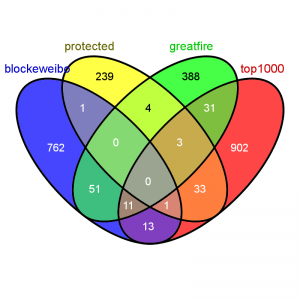
The China Chats keyword list was tested on Sina Weibo four times from Jun to Aug 2013. The data allows us to identify changes in censorship on Sina Weibo over time.