China
China’s censorship of social media platforms has largely been focused on speech that targets or criticizes the government, until recently. The Cyberspace Administration of China’s new regulations will target sexual innuendo, in particular 25 of the most popular “dirty words” in China.
Our report reveals that UC Browser poorly secures data in its English and Chinese language versions for Android.
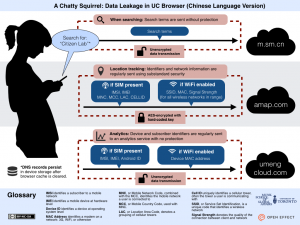
UC Browser is the most popular mobile web browser in China and India, boasting over 500 million users. This report provides a detailed analysis of how UC Browser manages and transmits user data, particularly private data, during its operation. Our research was prompted by revelations in a document leaked by Edward Snowden on which the Canadian Broadcasting Corporation (CBC) was preparing a story.
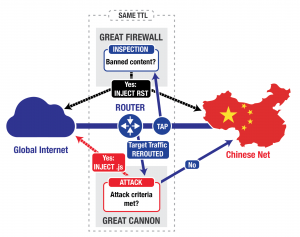
This post describes our analysis of China’s “Great Cannon,” our term for an attack tool that we identify as separate from, but co-located with, the Great Firewall of China. The first known usage of the Great Cannon is in the recent large-scale novel DDoS attack on both GitHub and servers used by GreatFire.org.
Senior Legal Advisor Sarah McKune has contributed a chapter to a new book from Oxford University Press, China and Cybersecurity: Espionage, Strategy and Politics in the Digital Domain (eds. Jon R. Lindsay, Tai Ming Cheung, Derek S. Reveron). Her chapter is entitled “’Foreign Hostile Forces’: The Human Rights Dimension of China’s Cyber Campaigns.”
According to state media organization People’s Daily, Apple agreed to Chinese government “security checks.” Citizen Lab Research Fellow Jason Q. Ng expressed concern that this practice may set a trend of compliance to such demands amongst other firms.
Hundreds of members of the Tibetan community are being targeted by email-based malware attacks that leverage the March 10 Tibetan Uprising anniversary as a theme. This report analyzes two March 10 related attacks. One using a new malware family we call MsAttacker , and another using the ShadowNet malware family and command and control infrastructure related to previous campaigns that targeted the Tibetan community.

Citizen Lab Research Fellow Jason Q. Ng commented on the effect that China’s real name registration policy will have on virtual private networks (VPNs) and self-censorship.
Citizen Lab partner and Cyber Stewards Network member Tibet Action Institute (TAI) released a documentary entitled “Tibet: Frontline of the New Cyberwar.”
Slate’s discussion on the proliferation of Chinese messaging applications worldwide was informed by Citizen Lab research report “Asia Chats: Analyzing Information Controls & Privacy in Asian Messaging Applications.”