telecommunications
Citizen Lab senior researcher Irene Poetranto writes for the Carnegie Endowment for International Peace about surveillance in Myanmar.
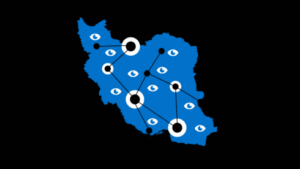
A confidential source sent the online news organization, The Intercept, a series of internal documents and communications providing details on what appear to be plans to develop and launch an Iranian mobile network, including subscriber management operations and services, and integration with a legal intercept solution. Some of this communication included representatives of the Communications Regulatory Authority of Iran (CRA). In October 2022, The Intercept shared this material with Citizen Lab researchers for analysis. The following report provides a summary of our analysis of this material and discusses its wider implications.
This report offers 30 recommendations to the draft legislation in an effort to correct its secrecy and accountability deficiencies, while also suggesting amendments which would impose some restrictions on the range of powers that the government would be able to wield. It is important that these amendments are seriously taken up due to the sweeping nature of the legislation.

On December 7, 2020, the Citizen Lab published a report that investigates Huawei, 5G technologies, and Canadian telecommunications issues. Drawing exclusively on open-source reporting, it finds that Canada does not have a Huawei problem, per se; it has a 5G strategy problem that is linked to the Government of Canada lacking a principle-driven set of integrated industrial, cyber security, and foreign policy strategies. This document provides a summary of the research findings and questions and answers from the research team.

Canadians can learn new things about your personal data by requesting access to it from companies. What can be found out varies by company and there can be some hurdles to overcome before you get access.
In this post, we critically examine the Government of Canada’s proposal to indiscriminately access subscriber identity information that is possessed by telecommunications service providers. We conclude by arguing that the government has failed to justify its case for such access to the information.

This report investigates the surveillance capabilities of IMSI Catchers, efforts by states to prevent information relating to IMSI Catchers from entering the public record, and the legal and policy frameworks that govern the use of these devices. The report principally focuses on Canadian agencies but, to do so, draws comparative examples from other jurisdictions. The report concludes with a series of recommended transparency and control mechanisms that are designed to properly contain the use of the devices and temper their more intrusive features.