WeChat and Sina Weibo adapted and evolved their censorship efforts in response to the death of Liu Xiaobo.

This report analyzes the information control practices related to a national crackdown on Chinese rights lawyers and activists on two leading Chinese social media networks. We document the Search filtering on Weibo, China’s Twitter-like service, as well as keyword and image censorship on WeChat, the most popular chat app in China.
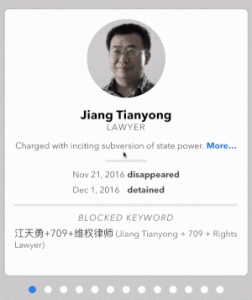
From January 2 to 13 2017, His Holiness the Dalai Lama is holding a popular Tibetan Buddhist teaching called Kalachakra in Bodh Gaya, India. Increased restrictions from the government of China has barred Tibetans in Tibet from attending the teachings. This report documents blocking of Kalachakra-related keywords on WeChat revealing how restrictions on the ritual extend online.

In this report we provide the first systematic study of keyword and website censorship on WeChat, the most popular chat app in China

This report is an analysis of the types of content removed by WeChat on its public accounts (also known as “official accounts”) blogging platform.
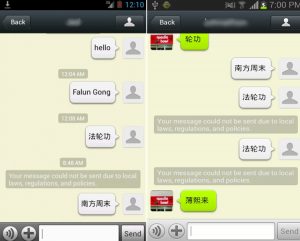
This post is an introduction to Asia Chats, a research project analyzing information controls and privacy in mobile messaging applications used in Asia. The project will produce a series of reports that will begin with a focus on WeChat, LINE, and KakaoTalk. Reports will include analysis based on our technical investigation of censorship or surveillance functionality, assessment of privacy issues surrounding these applications’ use and storage of user data, and comparison of the terms of service and privacy policies of the applications.