In an article for the Harvard Kennedy School’s Misinformation Review, Gabrielle Lim, doctoral fellow at The Citizen Lab, and co-authors Irene Pasquetto (University of Maryland) and Samantha Bradshaw (American University), discuss the complex challenges facing the field of misinformation.

Microsoft’s Digital Crimes Unit takes legal action to dismantle Russia-based threat actor COLDRIVER following a joint investigation by The Citizen Lab and Access Now. In August, The Citizen Lab, jointly with Access Now, in collaboration with First Department, Arjuna Team, and RESIDENT.ngo, published a report that uncovered two distinct spear-phishing campaigns targeting members of Russian […]
We are excited to announce a new book, Chasing Shadows: Cyber Espionage, Subversion, and the Global Fight for Democracy, by Ronald Deibert, director and founder of The Citizen Lab, will hit shelves on February 4, 2025.

In a joint investigation with Access Now, we found that seven Russian and Belarusian-speaking independent journalists and opposition activists based in Europe were targeted and/or infected with NSO Group’s Pegasus mercenary spyware.

We discovered over 60,000 unique censorship rules used to partially or totally censor search results across eight China-accessible search platforms analyzed. These findings call into question the ability of non-Chinese technology companies to better resist censorship demands than their Chinese counterparts.

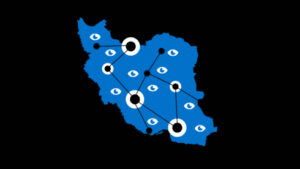
A confidential source sent the online news organization, The Intercept, a series of internal documents and communications providing details on what appear to be plans to develop and launch an Iranian mobile network, including subscriber management operations and services, and integration with a legal intercept solution. Some of this communication included representatives of the Communications Regulatory Authority of Iran (CRA). In October 2022, The Intercept shared this material with Citizen Lab researchers for analysis. The following report provides a summary of our analysis of this material and discusses its wider implications.
Citizen Lab researchers reviewed the consultation materials, including the “Technical Paper” and the “Discussion Guide” associated with the government’s proposal to address what it has referred to as “online harms.” We provide the following comments in response to that consultation process.

In this post, we discuss the significance of the findings from our report analyzing Apple product engraving services and observed censorship.

Within mainland China, we found that Apple censors political content including broad references to Chinese leadership and China’s political system, names of dissidents and independent news organizations, and general terms relating to religions, democracy, and human rights. And across all six regions, we found that Apple’s content moderation practices pertaining to derogatory, racist, or sexual content are inconsistently applied and that Apple’s public-facing documents failed to explain how it derives their keyword lists.