John Scott-Railton discusses the techniques he used to help identify individuals in the January 6th insurrection attempts on the US Capitol. Read the full story here.
Citizen Lab director Ronald Deibert joins Al Jazeera to discuss the growing harms of the global surveillance industry.
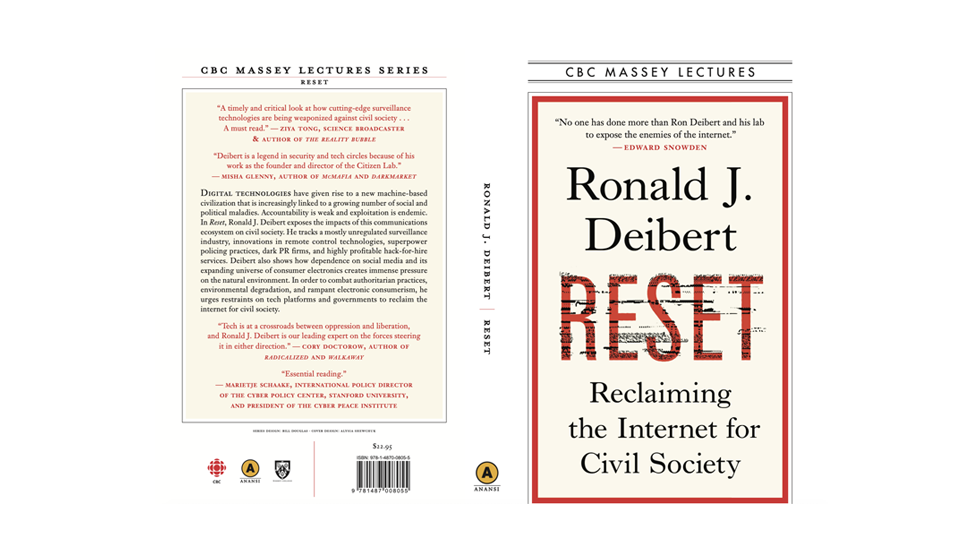
Citizen Lab director, Professor Ron Deibert, is this year’s 2020 CBC Massey Lecturer. Accompanying the lectures is a book authored by Deibert, entitled RESET: Reclaiming the Internet for Civil Society.
It is encouraging to see the provincial government undertake efforts to improve the state of privacy law in Ontario, given the increasingly ubiquitous data commodification and surveillance of our behaviours, bodies, online and offline activities, and lives. To that end, the Citizen Lab submitted a brief which included 21 recommendations for legal and policy reform in Ontario, with a view to strengthening the privacy and data protection rights of individuals in the province.
To ensure we can continue to deliver expert advice for years to come, the Citizen Lab is excited to announce that Security Planner is joining Consumer Reports (CR) Digital Lab.

Speaking with the Toronto Star, Citizen Lab senior research associate, Dr. Christopher Parsons, comments on the United Kingdom’s move to ban Huawei from the country’s 5G infrastructure. As Canada works to articulate its stance on the Chinese company, it must reconcile its unique relationship with Beijing.
Citizen Lab researchers alert pro-independence individuals were targeted in a “possible case of domestic political espionage.”
Titled Reset: Reclaiming the Internet for Civil Society, the five lectures will be delivered online, streamed on CBC Radio’s IDEAS, and published as a book by House of Anansi Press in September.
Targets were sent emails disguised as important communications, such as official summonses, bearing links to malicious software disguised as important documents. If opened, targets’ computers would have been infected with NetWire, a piece of commodity malware.
In order to build up its censorship algorithm, WeChat surveils international accounts to decide what gets through to China-registered users. A Citizen Lab study finds that the messaging app blacklisted more than 500 keyword combinations relating to the COVID-19 pandemic.