Brief
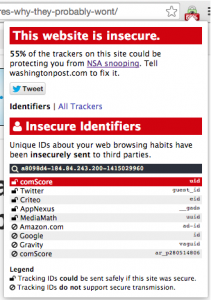
This post describes TrackerSSL, a browser extension that reveals the leaky ad trackers on webpages that leave your browsing habits open to surveillance.
Contained are links to a set of 9,054 sensitive Chinese keywords, which combine 13 existing lists. These keywords may be helpful to researchers who are searching for censored content in Chinese or testing for network interference.

We investigate what keywords might trigger censorship via automatic review in Sina Weibo and followed the pathways a typical censored post might take on Chinese social media.
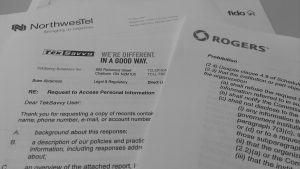
This post provides a summary of early findings associated with Canadians creating right to information requests using the Access My Info tool. It discusses several themes emergent from an analysis of company responses to such requests.
This edition of Social Media Watch deals with top court rulings on digital privacy, social media monitoring, and mobile security news.
By getting into the malware business the federal and potentially provincial governments of Canada would be confronted with an ongoing reality: is the role of government to maximally protect its citizens, including from criminals leveraging vulnerabilities to spy on Canadians, or is it to partially protect citizens so long as such protections do not weaken the state’s ability to secure itself from persons suspected of violating any Act of Parliament?
Social Media Watch returns with updates from the EU and US legal landscape, some notable cases of government access to personal data, and an overview of some important reports describing the need for updated regulation in the data economy.
In this post we explain how Canadians can issue requests to their telecommunications companies to learn what personal information those companies collect, retain, and disclose about them. We argue that Canadians should do this both to empower themselves and to enable Canadian policy experts and government officials to better hold the companies to account.
The Anti-Pornography Act 2014, the Public Order Management Act 2013, the Anti-Homosexuality Act 2014, the 2014 Press and Journalist regulations and the Non Government Organisation (NGO) Amendment bill have been criticised for creating unwarranted restrictions to liberties granted by the country’s 1995 constitution.
In this post we analyze the partial disclosures concerning Canada’s federal agencies’ domestic telecommunications surveillance practices. We argue that key federal agencies remain unaccountable to Parliamentarians and the Canadian public alike, and that accountability measures are urgently needed for Canadians to understand the extent of their federal government’s surveillance activities.