Report
In this report, we analyze the Windows, Android, and iOS versions of Tencent’s Sogou Input Method, the most popular Chinese-language input method in China. Our analysis found serious vulnerabilities in the app’s custom encryption system and how it encrypts sensitive data. These vulnerabilities could allow a network eavesdropper to decrypt sensitive communications sent by the app, including revealing all keystrokes being typed by the user. Following our disclosure of these vulnerabilities, Sogou released updated versions of the app that identified all of the issues we disclosed.

This report examines the accessibility of certain types of content on VK (an abbreviation for “VKontakte”), a Russian social networking service, in Canada, Ukraine, and Russia. Among these countries, we found that Russia had the most limited access to VK social media content, due to the blocking of 94,942 videos, 1,569 community accounts, and 787 personal accounts in the country.

In August 2019 a wave of websites and social media channels, called “HKLEAKS,” began “doxxing” the identities and personal information of pro-democracy activists in Hong Kong. While the creators of these sites and channels claimed that HKLEAKS was the product of local volunteer communities, several indicators suggest a coordinated information operation conducted by professional actors in alignment with Chinese state interests.

We conducted the first analysis of WeChat’s tracking ecosystem. Using reverse engineering methods to intercept WeChat’s network requests, we identified exactly what types of data the WeChat app is sending to its servers, and when. This report is part one of a two-part series on a privacy and security analysis of the WeChat ecosystem.

We discovered over 60,000 unique censorship rules used to partially or totally censor search results across eight China-accessible search platforms analyzed. These findings call into question the ability of non-Chinese technology companies to better resist censorship demands than their Chinese counterparts.

In 2022, the Citizen Lab gained extensive forensic visibility into new NSO Group exploit activity after finding infections among members of Mexico’s civil society, including two human rights defenders from Centro PRODH, which represents victims of military abuses in Mexico.

At least five civil society victims of QuaDream’s spyware and exploits were identified in North America, Central Asia, Southeast Asia, Europe, and the Middle East. Victims include journalists, political opposition figures, and an NGO worker. We identify traces of a suspected iOS 14 zero-click exploit used to deploy QuaDream’s spyware.

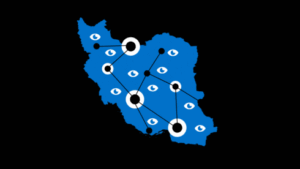
A confidential source sent the online news organization, The Intercept, a series of internal documents and communications providing details on what appear to be plans to develop and launch an Iranian mobile network, including subscriber management operations and services, and integration with a legal intercept solution. Some of this communication included representatives of the Communications Regulatory Authority of Iran (CRA). In October 2022, The Intercept shared this material with Citizen Lab researchers for analysis. The following report provides a summary of our analysis of this material and discusses its wider implications.
Police led mass iris scan collection in Qinghai, a region with a population that is 49.4% non-Han, including Tibetans and Hui Muslims. Iris scan collection is part of long-standing police intelligence gathering programs. Through this data collection, Qinghai’s police are effectively treating entire communities as populated by potential threats to social stability.

We investigate the collection of mobility data by the federal government of Canada, its legality under the existing and proposed privacy regime, and proposed recommendations for the reform of draft Bill C-27 which would address many of the issues in the governance of mobility data.