Asia Pacific
As part of our ongoing project monitoring changes to Chinese search censorship, we tracked changes to censorship following Li Keqiang’s death across seven Internet platforms: Baidu, Baidu Zhidao, Bilibili, Microsoft Bing, Jingdong, Sogou, and Weibo. We found that some keyword combinations in search queries triggers hard censorship whereas others trigger soft censorship. Our results demonstrate China’s ongoing efforts to push state-sanctioned narratives concerning politically sensitive topics, impacting the integrity of the online information environment.

What is this report about, and what did it find? The report is an in-depth analysis of the doxxing campaign known as “HKLEAKS”, which began in August 2019 and for at least two years targeted protesters active in the Anti-Extradition Bill 2019-20 Hong Kong protests. In February 2019, the Hong Kong government proposed a bill […]

In August 2019 a wave of websites and social media channels, called “HKLEAKS,” began “doxxing” the identities and personal information of pro-democracy activists in Hong Kong. While the creators of these sites and channels claimed that HKLEAKS was the product of local volunteer communities, several indicators suggest a coordinated information operation conducted by professional actors in alignment with Chinese state interests.
We conducted the first analysis of WeChat’s tracking ecosystem. Using reverse engineering methods to intercept WeChat’s network requests, we identified exactly what types of data the WeChat app is sending to its servers, and when. This report is part one of a two-part series on a privacy and security analysis of the WeChat ecosystem.

We discovered over 60,000 unique censorship rules used to partially or totally censor search results across eight China-accessible search platforms analyzed. These findings call into question the ability of non-Chinese technology companies to better resist censorship demands than their Chinese counterparts.

We discovered over 60,000 unique censorship rules used to partially or totally censor search results across eight China-accessible search platforms analyzed. These findings call into question the ability of non-Chinese technology companies to better resist censorship demands than their Chinese counterparts.
At least five civil society victims of QuaDream’s spyware and exploits were identified in North America, Central Asia, Southeast Asia, Europe, and the Middle East. Victims include journalists, political opposition figures, and an NGO worker. We identify traces of a suspected iOS 14 zero-click exploit used to deploy QuaDream’s spyware.

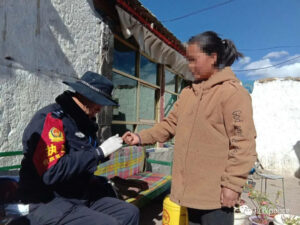
Police led mass iris scan collection in Qinghai, a region with a population that is 49.4% non-Han, including Tibetans and Hui Muslims. Iris scan collection is part of long-standing police intelligence gathering programs. Through this data collection, Qinghai’s police are effectively treating entire communities as populated by potential threats to social stability.

We find that mass DNA collection in Tibet is another mass DNA collection campaign conducted under the Xi Jinping administration (2012–present), along with the mass DNA collection campaign in the Xinjiang Uyghur Autonomous Region and the police-led national program of male DNA collection.
Our investigation uncovered an extensive Pegasus hacking operation against pro-democracy campaigners in Thailand. At least 30 forensically-confirmed victims of NSO Group’s Pegasus spyware between October 2020 and November 2021.