China
Citizen Lab Researcher Lotus Ruan was interviewed by VOA Mandarin on the recent release of the report entitled “One App Two Systems, How WeChat uses one censorship policy in China and another internationally.”
Director Ron Deibert spoke to CNN International on Citizen Lab’s recent report, titled “One App, Two Systems: How WeChat uses one censorship policy in China and another internationally.” Deibert commented on trends of censorship and surveillance in China, and Asian instant messaging applications more broadly.
In this report we provide the first systematic study of keyword and website censorship on WeChat, the most popular chat app in China

In this report we provide the first systematic study of keyword and website censorship on WeChat, the most popular chat app in China
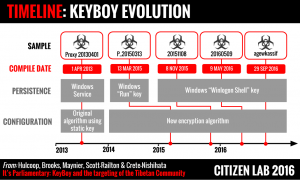
In this report we track a malware operation targeting members of the Tibetan Parliament that used known and patched exploits to deliver a custom backdoor known as KeyBoy. We analyze multiple versions of KeyBoy revealing a development cycle focused on avoiding basic antivirus detection.
In a recent speech, Ali Baba co-founder Jack Ma suggested that the Chinese government should use big data to help prevent crime, a view that resonates with the Communist party’s efforts to establish a system parsing citizen information online. Citizen Lab Senior Research Fellow Jason Q. Ng commented on Ma’s remarks in an interview with Bloomberg.
In this report, we reverse engineer three popular live streaming platforms (YY, Sina Show, and 9158) and find keyword lists used to censor chat messages. Tracking changes to the keyword lists over the past year gives an inside look into how these applications implement censorship

In an interview with the Daily Dot, Citizen Lab Research Manager Masashi Crete-Nishihata commented on the challenges Tibetans face in using social media and other online tools to spread content considered politically sensitive by the Chinese government.
Citizen Lab Research Manager Masashi Crete-Nishihata was interviewed by Al Jazeera regarding censorship practices in popular Asian instant messaging applications.

In this report we analyze Windows and Android versions of web browser UC Browser, and find they transmitted personally identifiable information with easily decryptable encryption and were vulnerable to arbitrary code execution during software updates.